> ## Documentation Index
> Fetch the complete documentation index at: https://docs.coval.ai/llms.txt
> Use this file to discover all available pages before exploring further.
# How to Review a Conversation
> For reviewers: open your assignments, label each metric, apply triage labels, and move quickly.
This page is for the people doing the reviewing. If you're setting up or managing a project, see [Human Review Projects](/concepts/metrics/human-review/human-review).
## Open your assignments
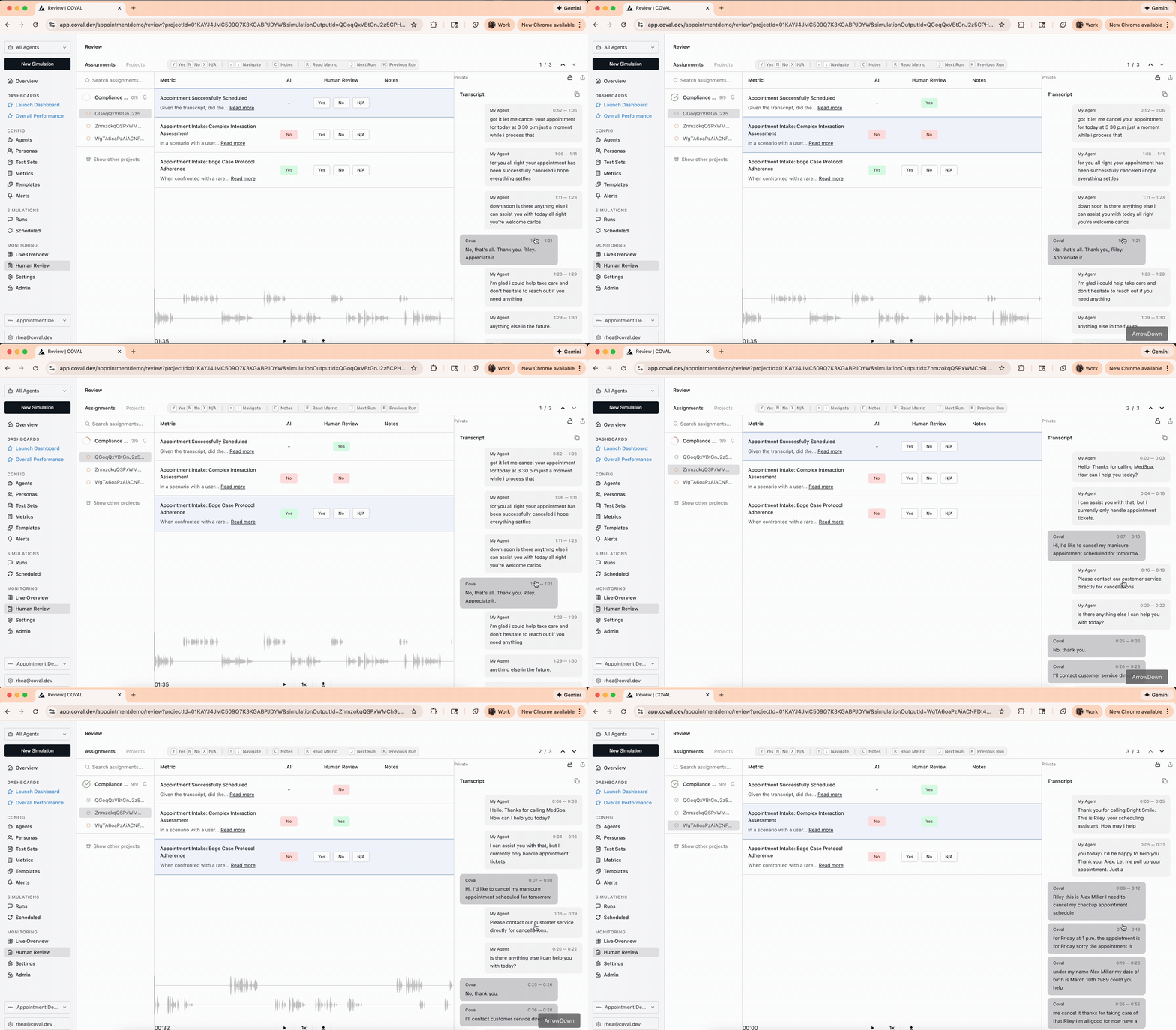
Go to the **Human Review** page in the Coval dashboard. The **Assignments** tab lists every annotation assigned to you. Click one to open the review interface: the conversation transcript — with an audio player for voice calls — alongside the metrics to evaluate.
## Label each metric
Read the transcript, listen to the audio where relevant, and give your ground-truth answer for each metric. How you answer depends on the metric type.
### Direct value metrics
You give a single value for the whole conversation.
* **Binary (Pass/Fail)** — select **Yes**, **No**, or **N/A**. Applies to binary LLM judge, audio binary judge, and agent-repeats-itself.
* **Numerical** — enter a number within the configured min/max range. Applies to numerical and audio numerical judges.
* **Categorical** — choose from a configured dropdown. Applies to categorical and audio categorical judges.
* **Transcript sentiment** — pick a sentiment label (e.g. Rude, Polite, Encouraging, Professional).
* **Composite evaluation** — assess each criterion with **MET / NOT\_MET / UNKNOWN**.
### Audio region metrics
Mark or edit regions on the audio waveform timeline. These require an audio recording on the conversation, and cover interruption rate, latency, abrupt pitch changes, volume/pitch misalignment, non-expressive pauses, vocal fry, music detection, time to first audio, volume variance, custom pause analysis, and agent-needs-reprompting.
### Per-segment labeling
Assign a label to each speaking segment — for **audio sentiment**, mark each segment as Neutral, Angry, Happy, or Sad.
### Per-message review
Provide a value for each message — for **words per message**, the word count of each assistant message.
Not all metrics support human review — only those with a defined annotation mechanism appear in the review interface.
 ## Applying triage labels
If your project has [triage labels configured](/concepts/metrics/human-review/human-review#set-up-a-project), apply the ones that fit each conversation. Triage labels are independent of your metric answers — they're your own categories (failure type, theme, severity, follow-up) for sorting and grouping conversations afterward. Tag a call with as many as apply as you go.
## Add notes
Optionally add a note to explain a labeling decision. Notes can be placed anywhere in the review interface and are visible to project collaborators — when a project requires **disagreement notes**, this is where you record why you disagreed with the metric.
## Review fast with the keyboard
The interface is built for speed. Navigate rows with `j` / `k`, open an assignment with `Enter`, move between neighboring conversations with `h` / `l` (or `a` / `d`, or the arrow keys), and back out of a surface with `b` or `Escape`. See the [Keyboard Navigation guide](/guides/keyboard-navigation) for the full model.
## Applying triage labels
If your project has [triage labels configured](/concepts/metrics/human-review/human-review#set-up-a-project), apply the ones that fit each conversation. Triage labels are independent of your metric answers — they're your own categories (failure type, theme, severity, follow-up) for sorting and grouping conversations afterward. Tag a call with as many as apply as you go.
## Add notes
Optionally add a note to explain a labeling decision. Notes can be placed anywhere in the review interface and are visible to project collaborators — when a project requires **disagreement notes**, this is where you record why you disagreed with the metric.
## Review fast with the keyboard
The interface is built for speed. Navigate rows with `j` / `k`, open an assignment with `Enter`, move between neighboring conversations with `h` / `l` (or `a` / `d`, or the arrow keys), and back out of a surface with `b` or `Escape`. See the [Keyboard Navigation guide](/guides/keyboard-navigation) for the full model.