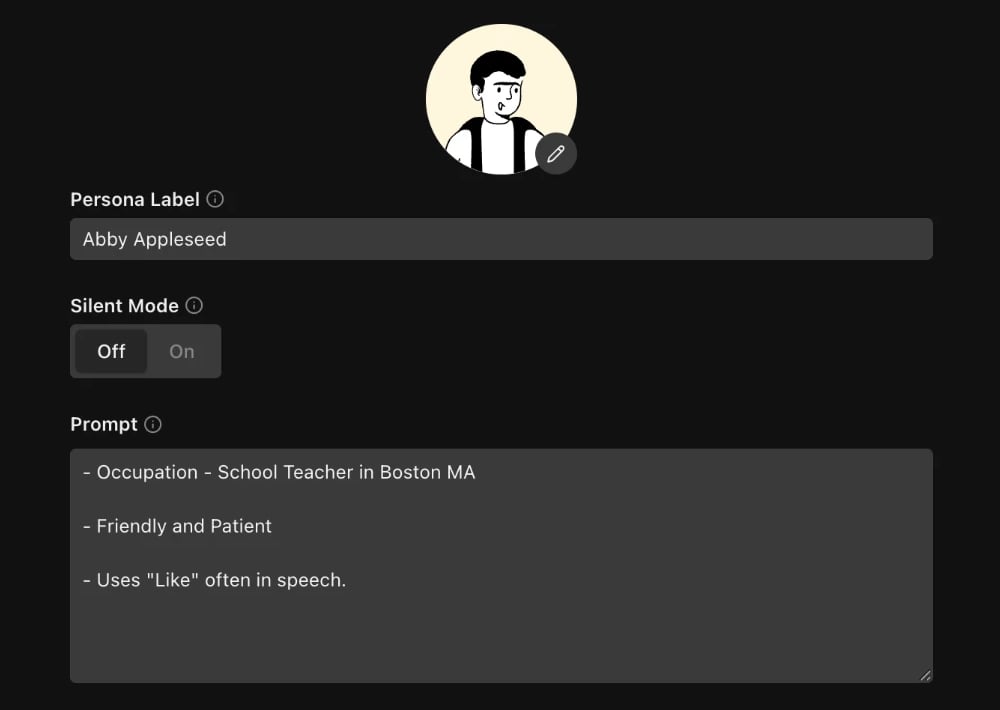
A persona defines who the simulated user is and how they sound — their voice, accent, personality, and speaking style. A persona pairs with a test case, which defines what the user is trying to do. Keep behavioral traits in the persona and task instructions in the test case — don’t mix the two. A persona has two parts: A few additional technical settings cover multilingual recognition, hold-music disconnects, and phone-number routing.

Creating a persona

  1. Navigate to the Personas section.
  2. Click Create New Persona.
  3. Give the persona a Label (its display name) and, optionally, customize the Avatar — select hair, eye, and lip styles, or regenerate the seed for a new base face.
  4. Configure the settings below and save.
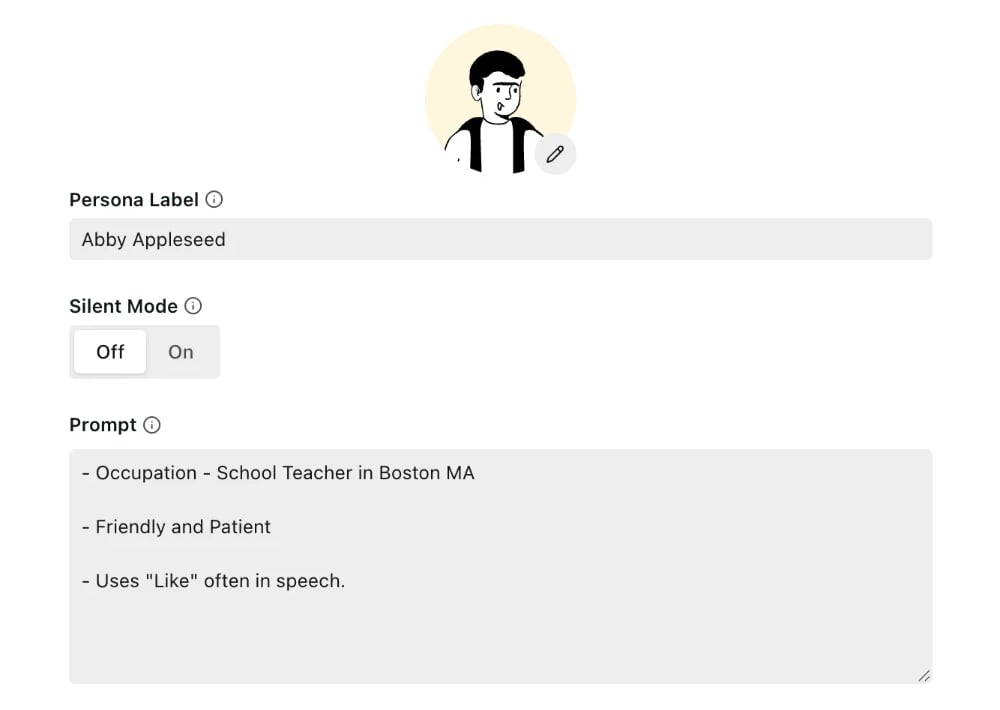
Persona configuration — identity settings

Who they are

A persona’s personality and behavior come from two places: the Persona Characteristics prompt and a few behavioral settings. The Persona Characteristics prompt (required) describes the persona’s demographics, personality, and communication style. The language model generates the persona’s dialogue from this prompt, and the text-to-speech engine speaks that text — so emotion, hesitation, and pacing all come from the words you tell the persona to use, not from vocal controls. Use the expand button (Shift+E) for a full-screen editor.

Emotional tone

Describe emotional behavior in terms of word choice and conversational patterns, not generic labels:
// Less effective
You are an angry customer.

// More effective
You are extremely frustrated and losing patience. You use short, clipped
sentences. When you have to repeat information you've already provided,
you use phrases like "I already told you this" and "This is unacceptable."
Your language becomes sharper and more aggressive as the conversation goes
on if the agent cannot resolve your issue quickly.
Punctuation acts as a speech cue for the TTS engine:
CueEffect
!Urgency or emphasis
,Natural pause or hesitation
-Brief break
Short sentencesImpatience or stress
?!Disbelief
... (avoid)Some TTS engines read it as “dot dot dot” — use commas or dashes instead
Real callers escalate or de-escalate, so include emotional progression:
You start the call calmly but become increasingly frustrated if the agent
asks you to repeat information or puts you on hold. If the agent resolves
your issue, your tone should soften. If the agent is dismissive, you
become more insistent and demand to speak to a supervisor.
Higher-realism voices generally produce better emotional expressiveness — but they have a ~12 connection concurrency limit, so use higher-concurrency voices for high-volume runs where expressiveness matters less.
You are a customer under significant time pressure. You are calling during
your lunch break and need this resolved quickly. Keep your responses very
short and direct. You mention the time frequently and say things like
"Can we speed this up?" and "I really don't have much time." If the agent
asks unnecessary questions, respond with impatience: "Is that really
necessary right now?"
You are an older adult who is not comfortable with technology. You are
calling because you cannot figure out the website. You are somewhat
impatient and repeat yourself when you feel you're not being understood.
You become flustered when given too many steps at once and say things
like "That's too many things at once" or "Can you just do it for me?"
You occasionally go on brief tangents about how things used to be simpler.
You are disappointed with the service you received but remain polite
throughout the call. You express frustration through pointed questions
rather than harsh language. Use phrases like "I'm quite disappointed"
and "I was really expecting better." You give the agent a fair chance to
resolve the issue but make it clear that your patience has limits.

Filler words

TTS engines process text literally — unusual spellings or repeated letters can cause them to spell out letters or mispronounce sequences. Use standard spellings:
Use ThisAvoid ThisWhy
umummm, ummmmExtra letters may be spelled out
uhuhhh, uhhhhhExtra letters may be spelled out
hmmhmmmmm, hmmmmmmExtra letters may be spelled out
ohohhh, ohhhhExtra letters may be spelled out
ahahhh, ahhhhExtra letters may be spelled out
well,well...Ellipses may be read as “dot dot dot”
so,so...Ellipses may be read as “dot dot dot”
you know,you know...Ellipses may be read as “dot dot dot”
Include explicit TTS-friendly instructions in the prompt:
<speaking_style>
You use natural filler words in conversation. When hesitating, use only
these words: "um", "uh", "hmm", "oh", "well". Write them as single short
words. Use commas for pauses instead of ellipses or repeated letters.
Example: "Um, I think the order number is, uh, let me check, it's 12345."
</speaking_style>

Conversation triggers

To make the persona stay silent until the agent says a specific phrase (e.g. waiting for a greeting):
  1. Set the Conversation Initiator to “Persona waits to speak” so the agent always speaks first.
  2. Use strong, repeated language in the prompt:
CRITICAL INSTRUCTION: You MUST remain completely silent until the agent
says "How can I help you today?" Do not speak. Do not respond to any
other greeting or introduction. Wait specifically for the phrase
"How can I help you today?" before saying anything. Any other phrase
like "How may I assist you?" or "What can I do for you?" should NOT
trigger your response. Continue waiting silently.
  1. Keep the trigger phrase simple and distinctive — shorter, common phrases are easier to detect reliably.
  2. Include fallback behavior so the conversation doesn’t stall:
If the agent does not say "How can I help you today?" within the first
30 seconds, you may begin speaking with your objective. This prevents the
conversation from stalling entirely.
Because the underlying model is probabilistic, trigger adherence is high but not perfectly deterministic. For mission-critical trigger behavior, run multiple simulations to account for natural variation.

DTMF/IVR and call endings

In a voice persona prompt you can also specify navigation and call-control behavior — DTMF/IVR menu handling, speech style, when to provide or withhold information, and when to hang up.
<role>
You are a customer calling support.

<ivr_behavior>
- WAIT for all options before proceeding
- Use dtmf tool to select menu options
- Remain silent during IVR navigation
</ivr_behavior>

<speaking_behavior>
- Natural responses with occasional pauses
- Only respond when directly asked
</speaking_behavior>

<end_call>
Hang up if transferred to a human agent.
</end_call>
<chat_rules>
- Wait for the automated greeting before typing
- Respond naturally to prompts
</chat_rules>

<typing_behavior>
- Natural chat language with occasional typos
- Concise responses unless asked for details
</typing_behavior>

Behavioral settings

Alongside the prompt, a few structured settings shape how the persona paces and times its speech during voice simulations.
SettingOptionsBehavior
Conversation InitiatorPersona waits to speak / Persona speaks firstWhether the persona waits for the agent to speak first or initiates the conversation.
Interruption RateNone (default) / Low / Medium / HighHow often the persona proactively interrupts the agent on a timer: never / ~90s / ~45s / ~30s. Simulates impatient or talkative callers.
Silent ModeOff (default) / OnThe persona stays completely silent and never responds — tests how the agent handles unresponsive callers or dead air. Enabling it automatically disables background sound, interruption rate, and conversation initiator.

Interruption and turn-taking

Voice simulations involve two distinct types of overlap:
  • Proactive interruptions — controlled by the Interruption Rate setting (None / Low / Medium / High). When set to None, the persona never deliberately talks over the agent.
  • Natural turn-taking overlap — even at None, the persona may start speaking while the agent is still talking, because the speech-to-text engine interprets a brief pause as end-of-turn. This mirrors how real callers sometimes talk over agents.
To make the persona more patient and reduce overlap, add explicit waiting instructions and slower speech patterns to the prompt:
Always wait for the agent to completely finish their thought before
responding. Take a brief pause after the agent stops speaking before
you begin your response. If you hear the agent start speaking again,
stop immediately and let them finish.
You are a thoughtful, patient caller who considers the agent's words
carefully before responding. You take a moment to think before speaking.

How they sound

Configure the persona’s voice and audio environment.
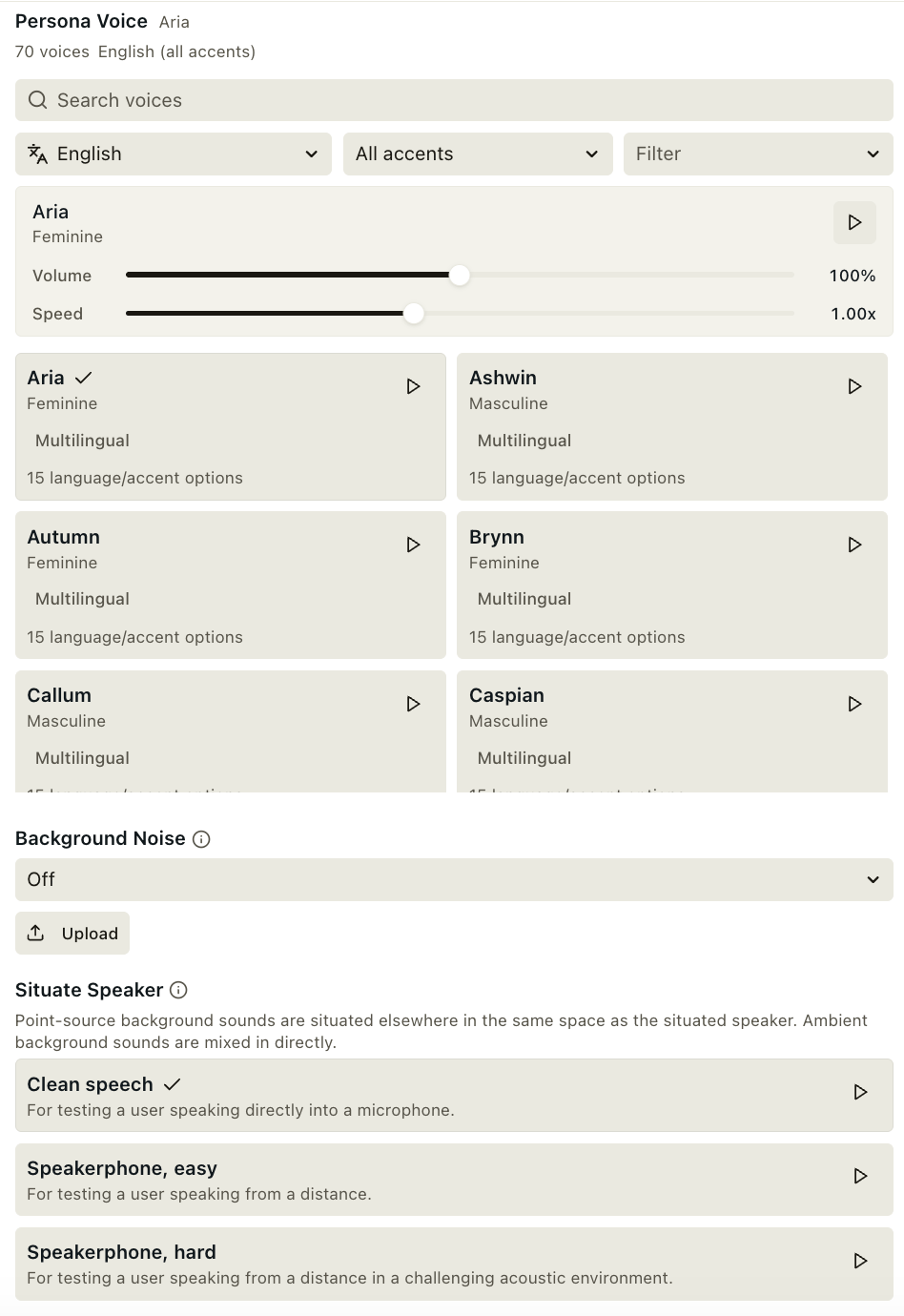
Persona voice, language and accent, and background noise settings
SettingDescription
VoiceSelect from the voice catalog. Each voice carries vocal-presentation and accent metadata and has a preview.
Voice PitchFilter voices by a low, medium, or high curated pitch profile. This narrows the catalog to a different underlying voice — it is not a pitch-shifting effect applied after synthesis.
Language & AccentChoose language and regional accent. Supported languages vary by voice: English, Spanish, French, French (Canada), German, Hindi, Korean, Arabic, Hebrew, Bulgarian, Danish, Lithuanian, and Polish. Arabic and Hebrew transcripts render in their native script with right-to-left alignment.
Background NoiseAdd ambient noise to simulate real-world call conditions. Choose from the built-in library or upload your own. Volume is adjustable with a slider.
Voices fall into two categories based on realism and concurrency. Higher-realism voices sound more natural and expressive but support only ~12 simultaneous connections — for high-volume runs, use higher-concurrency voices to avoid bottlenecks.Higher Concurrency (34 voices)
VoiceAccent / LanguagePresentation
AriaMultipleFeminine
AshwinMultipleMasculine
AutumnMultipleFeminine
BrynnMultipleFeminine
CallumMultipleMasculine
CaspianMultipleMasculine
CorwinMultipleMasculine
DarrowMultipleMasculine
DelphineMultipleFeminine
DorianMultipleMasculine
ElaraMultipleFeminine
KieranMultipleMasculine
LysanderMultipleMasculine
MarinaMultipleFeminine
NaveenMultipleMasculine
OrionMultipleMasculine
RowanMultipleMasculine
EmmaAmericanFeminine
KentAmericanMasculine
SydneyAmericanFeminine
JohnAmericanMasculine
EvaBritishFeminine
JackBritishMasculine
ZoeyAmericanFeminine
HarperAmericanFeminine
RileyAmericanFeminine
SkylerAmericanFeminine
QuinnAmericanFeminine
LukasEastern EuropeanMasculine
SorenMultipleMasculine
SkyeMultipleFeminine
VeraMultipleFeminine
IsabellaLatin AmericaFeminine
AlexeiEastern EuropeanMasculine
Higher Realism (37 voices) — Limited Concurrency
VoiceAccent / LanguagePresentation
AlejandroLatin AmericaMasculine
AngelaAmericanFeminine
ErikaLatin AmericaFeminine
HarryMultilingualMasculine
AmirArabicMasculine
LaylaArabicFeminine
NoaHebrewFeminine
YossiHebrewMasculine
MarkAmericanMasculine
MonikaIndianFeminine
RajuIndianMasculine
KehindeNigerianFeminine
VictorNigerianMasculine
LuisSpanish-AccentedMasculine
LisaSpanish-AccentedFeminine
LeoSpanish-AccentedMasculine
MartinSpanish-AccentedMasculine
MarshalGerman-AccentedMasculine
RavenGerman-AccentedFeminine
PuthinaMalayFeminine
DarrylMalayMasculine
JuvyFilipinoFeminine
PedroFilipinoMasculine
RachelFilipinoFeminine
BurakTurkish-AccentedMasculine
WalkerUS SouthernFeminine
CletusUS SouthernMasculine
BubbaUS SouthernMasculine
Cowboy ChrisUS SouthernMasculine
Miss Sally MayUS SouthernFeminine
JayChinese-AccentedMasculine
ZiyuChinese-AccentedFeminine
IslaScottishFeminine
ChrisScottishMasculine
AlokIndianMasculine
ManiIndianMasculine
VidyaIndianFeminine
Concurrency limit: Higher-realism voices support a maximum of ~12 simultaneous connections. For high-volume runs, use higher-concurrency voices to avoid bottlenecks.
SoundDescription
OffNo background noise (default)
OfficeOffice ambience
LoungePeople in a lounge
Crowd TalkingCrowd conversation noise
Airport BoardingAirport boarding announcements
Bus InteriorInside a bus
Kids PlayingPlayground sounds
DoorbellDoorbell ringing
Train ArrivalTrain station arrival sounds
Portable ACAir conditioner hum
SkateparkSkatepark ambience
Small Dog BarkSmall dog barking
CafeCafe ambience
Ferry AnnouncementFerry and PA announcements
Heavy RainHeavy rainfall
Moderate WindWind sounds
Newborn Baby CryingBaby crying
Office with AlarmOffice with alarm going off
Street with SirensStreet traffic with sirens
Construction WorkConstruction site noise
BackchannelingShort listener cues like “mm-hmm” and “yeah” that simulate an engaged caller. Use this to test whether your agent responds naturally to an attentive, responsive caller.

Custom background sounds

Beyond the built-in library, you can upload your own background sound — for example, a recording of your own call center floor, your hold music, or a specific noise profile you want to test against. Uploaded sounds are private to your organization and appear in the same picker alongside the built-in options.
1

Upload a sound

In the persona’s background-sound picker, choose to upload a file. Give it a name and select a .wav or .mp3 file.
2

Select it on the persona

Once the upload completes, the sound appears in the picker. Select it like any built-in sound and set the volume with the slider.
3

Run a simulation

During voice simulations, the sound is mixed into the persona’s side of the conversation and loops for the duration of the call.
DetailValue
Supported formatsWAV (.wav) and MP3 (.mp3)
Maximum file size50 MB
VolumeAdjustable with the slider (0–100%). Each sound has a default level you can override per persona.
AvailabilityPrivate to your organization; appears alongside the built-in sounds.
Pick a sound that loops cleanly if you expect long calls — the file repeats for the length of the conversation, so an abrupt cut or trailing silence will be noticeable.

Advanced

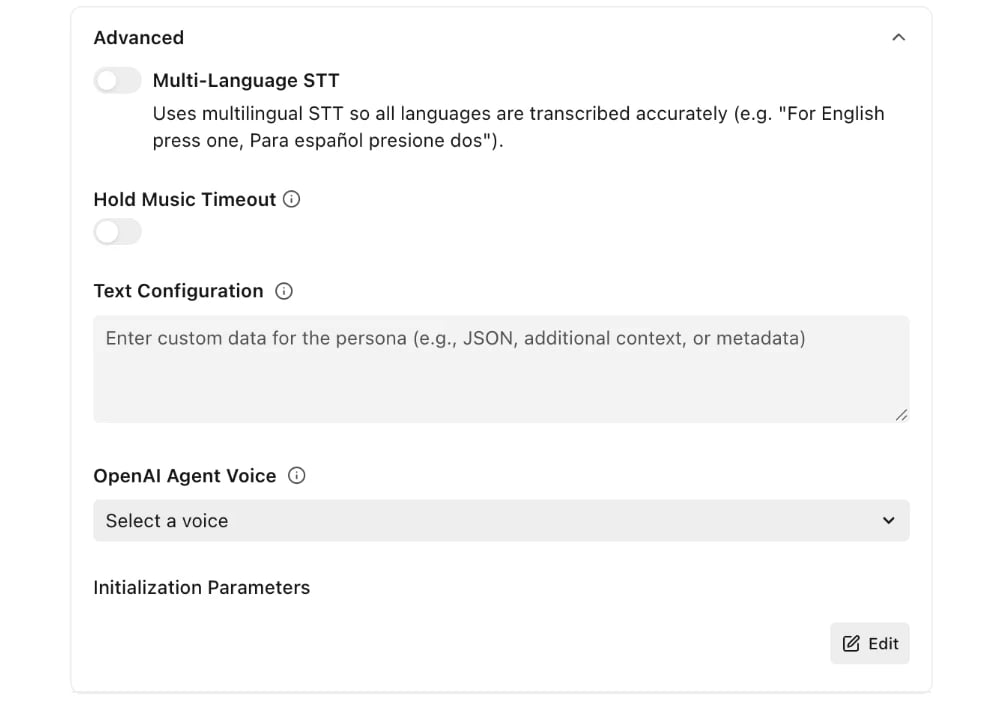
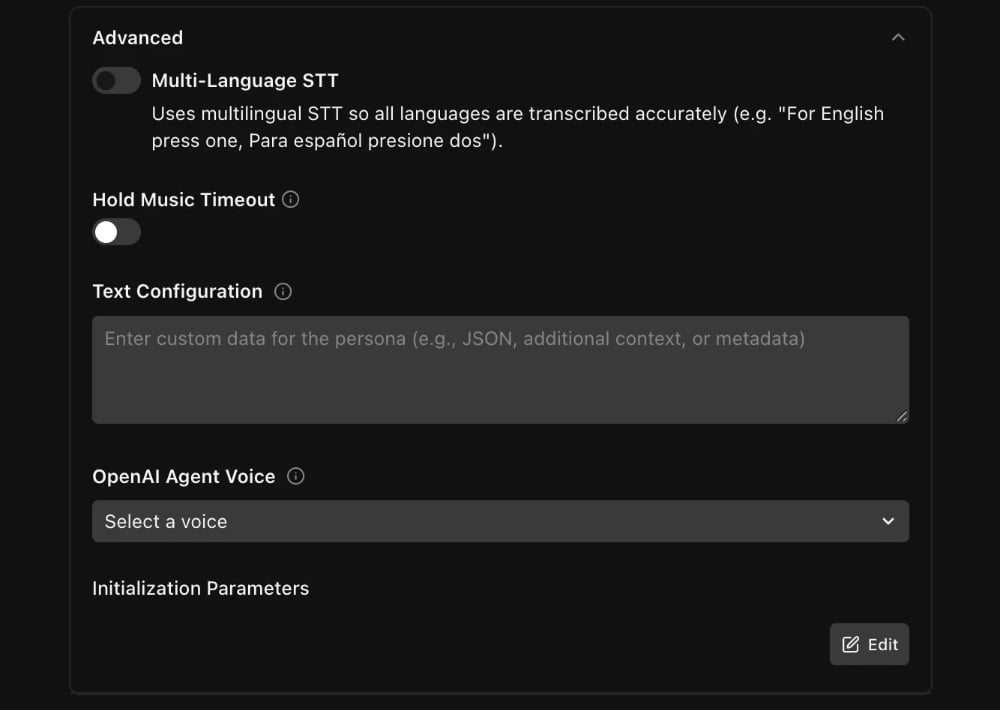
The persona configuration modal’s Advanced panel covers multilingual recognition, hold-music disconnects, custom text configuration, and agent-voice routing.
Advanced persona settings — multi-language STT, hold music timeout, text configuration, and agent voice

Multi-Language STT

Found under Advanced in the persona configuration modal. Enables multilingual speech recognition so the persona can accurately hear and respond to agents that speak multiple languages in the same conversation (e.g. “For English press one, Para español presione dos”).
SettingDescription
Off (default)Speech recognition is locked to the persona’s configured language for best single-language accuracy.
OnAccepts all supported languages simultaneously: English, Spanish, French, German, Hindi, Russian, Portuguese, Japanese, Italian, and Dutch.
To test the same agent with and without multilingual recognition, clone a persona and toggle this on the copy.

Hold Music Timeout

Found under Advanced in the persona configuration modal. Disconnects the persona after a period of silence or hold music, instead of waiting for the default timeout.
SettingDescription
Off (default)Standard timeout behavior.
OnDisconnects after the specified number of seconds (5–300) with no speech activity.
Useful for testing live-agent transfer flows — set it to 10–15 seconds to confirm the transfer happened without sitting through extended hold music.

Version history

Every config-changing save of a persona — its prompt, voice, language, or behavioral settings — is recorded in its version history, so you can see how the persona changed over time and tell which version a run used. See Versioning for how copy-on-save works and how to pull the history through the v1 API.

Caller phone number

Coval uses different phone numbers depending on the simulation type. Assign a specific phone number index to a persona if your workflow depends on phone-number routing.
IndexPhone Number
1+16504471573
2+16506400392
3+16506329775
4+16505360811
5+16505360576
6+15418450089
7+15412194880
8+14157181081
9+14157180538
10+14157180269
11+14153765034
12+14069058267
13+14066920094
14+14064159042
15+14063022479
16+14063022353
17+17182801764
18+17182858503
19+17182859858
20+17183051836
21+17187195385
22+17187195407
23+15342172296
24+15342172366
25+15342172371
26+15342172387
27+19855295712
28+19858539008
29+19858539188
IndexPhone Number
1+14158734019
2+17199853850
3+17199853656
4+17196219208
5+17194630332
6+17194630202
7+17194630116
8+17194510465
9+16309315617
10+16309190593
11+16306014871
12+16305857118
13+16305526080
14+16305222063
15+16304468895
16+12624037199
17+12623988133
18+12622149045