

Template variables
You can embed dynamic values from agents, test cases, and uploaded conversations into your metric prompts using template variables. The system replaces each placeholder with the actual value for the simulation or conversation being evaluated, so one metric adapts to many configurations.{{agent.*}} — Agent attributes
Reference custom properties defined on the agent configuration with {{agent.attribute_name}}. The placeholder is replaced with the attribute value from the agent under evaluation.
{{expected_output.*}} — Test case expected outputs
Reference values from a test case’s expected output with {{expected_output.<key>}}. For a test case whose expected output carries source, destination, and ticket_class:
{{customer_metadata.<key>}} — Upload-time values
Reference per-conversation values you provide at upload time with {{customer_metadata.<key>}}. This is useful for evaluating monitored production calls against ground truth known only at upload time — prices, order totals, confirmation numbers, expected outcomes. Each conversation is judged against its own metadata value.
See Customer Metadata (Upload-Time Values).
For full documentation — nested paths, array indexing, dynamic keys, and examples — see Attributes.
Transcript scope
Transcript Scope focuses metric evaluation on specific portions of a conversation rather than the entire transcript, reducing noise and improving accuracy for targeted assessments. It is available for all LLM Judge metrics (Binary, Numerical, Categorical) and Multimodal/Audio LLM Judge metrics.Configuration
Set the Transcript Scope toggle to:- Full (default) — Evaluate the entire transcript.
- Custom — Apply filters to focus on specific messages.
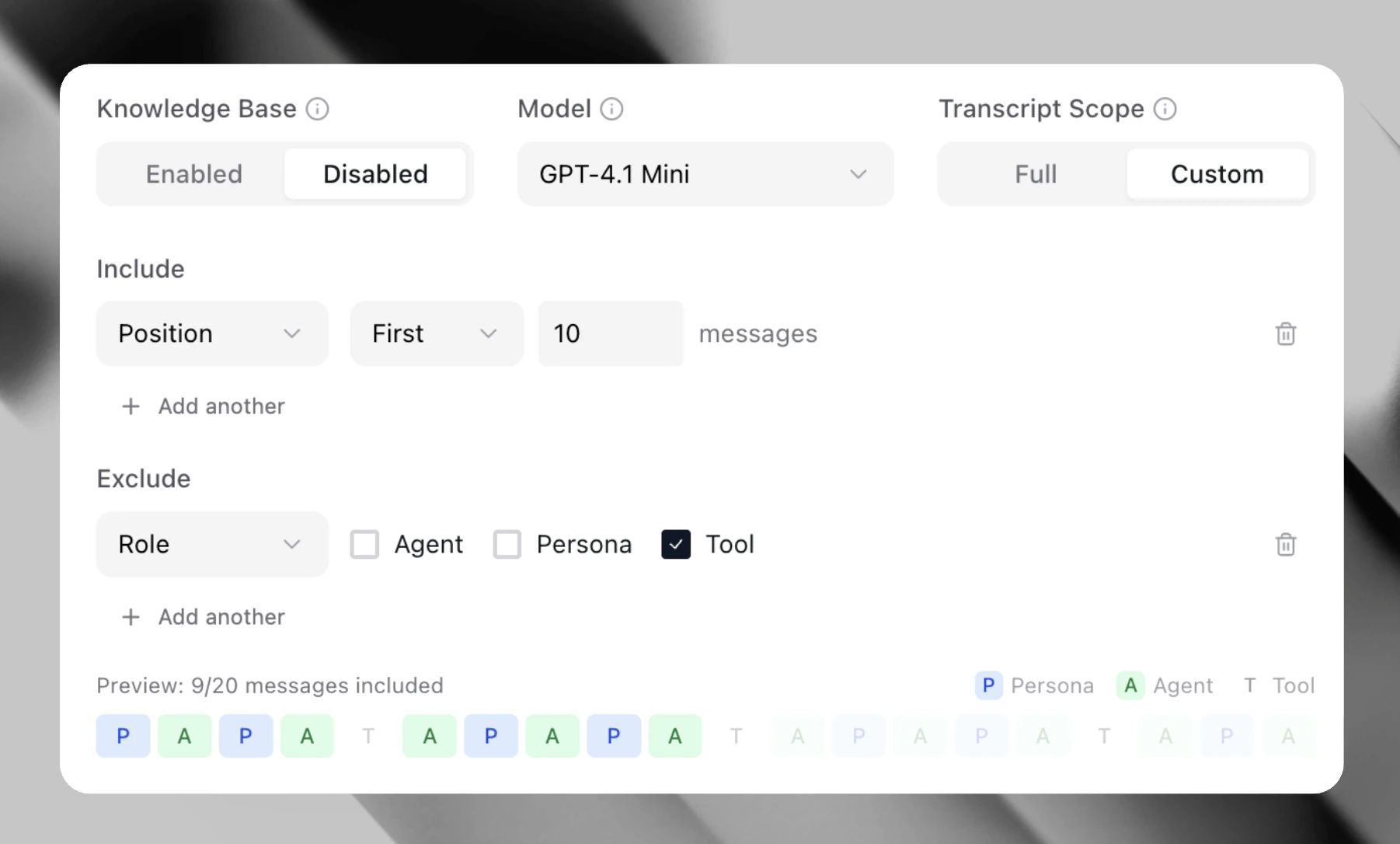
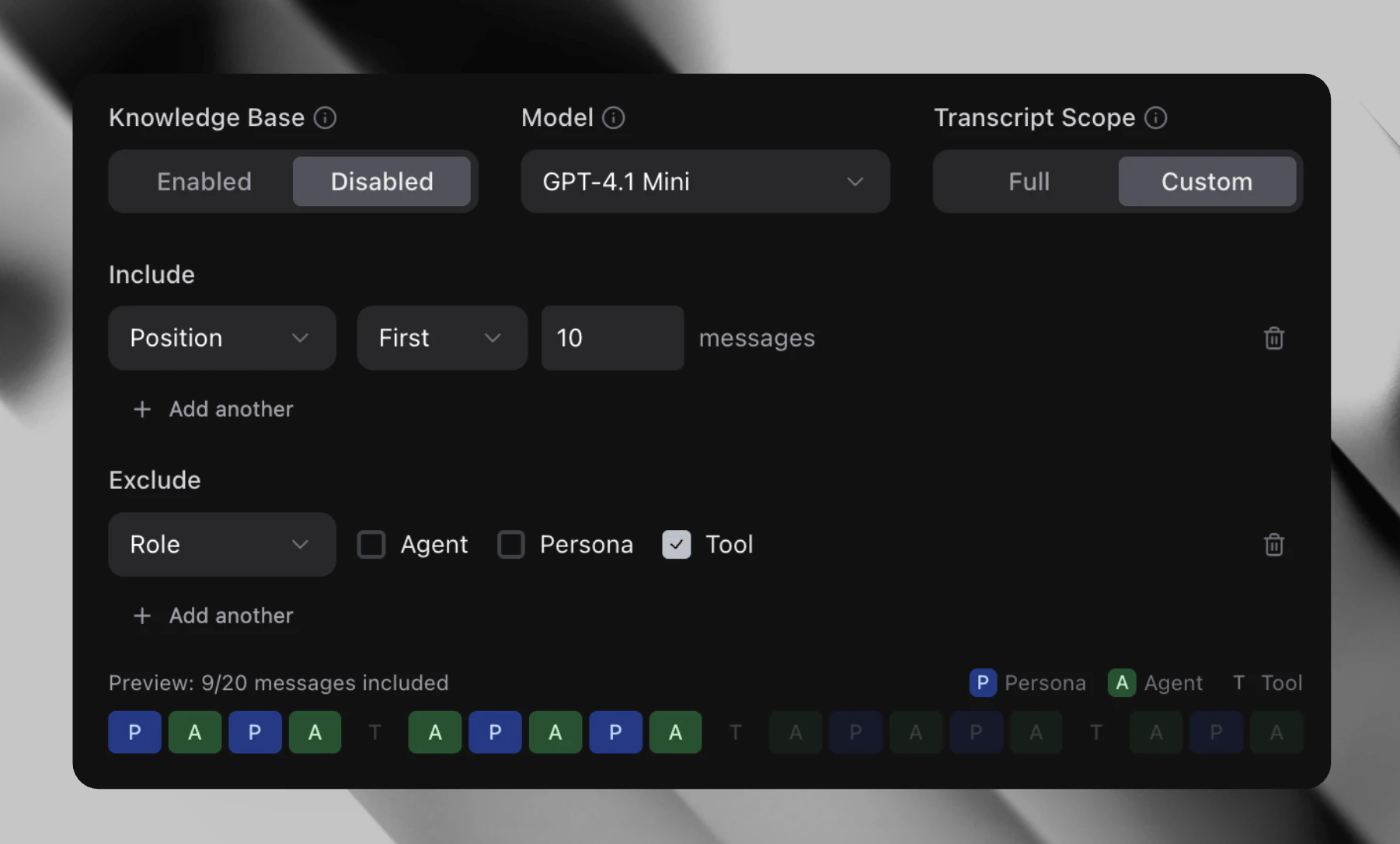
Role filter
Role filter
Limit evaluation to messages from specific speakers:
- Agent — Only assistant/agent messages
- User — Only user/customer messages
- Both — Messages from the selected roles
Range filter
Range filter
Limit evaluation to a portion of the conversation:
- Last N turns — Only the final N message exchanges
- First N turns — Only the opening N message exchanges
Scope for audio metrics
When using Transcript Scope with Multimodal/Audio LLM Judge metrics, Coval automatically:- Filters the transcript to the selected messages.
- Uses message timestamps to extract the corresponding audio segments.
- Merges adjacent segments (within 0.5 seconds) to avoid artifacts.
- Sends only the filtered audio to the LLM.
Benefits
- More accurate — Removes noise from irrelevant messages.
- Lower cost — Processes less content per evaluation.
- Faster — Smaller context means quicker LLM responses.
Trace context
Trace Context gives an LLM Judge or Composite Evaluation metric visibility into what your agent actually did — not just what it said — by including OpenTelemetry span data alongside the transcript. When Include Traces is enabled on a custom transcript scope, the judge receives aTRACE CONTEXT: block appended to its prompt. This block summarizes the conversation’s OTel spans: span names, timing windows, and key attributes like tool call names and function arguments. Speech-recognition spans also contribute the text that was recognized, so a judge can assess what the agent actually heard; long values are truncated to keep the block within its size budget. For Composite Evaluation metrics the same block is appended to every per-criterion prompt.
When to enable
Trace context is most useful when the behavior you want to evaluate isn’t visible in the transcript alone:How to enable
- Open or create a supported metric — LLM Judge (Binary, Numerical, Categorical, or Audio) or Composite Evaluation.
- Set Transcript Scope to Custom.
- In the custom scope panel, toggle Include Traces on.
Requirements
- Your agent must emit OpenTelemetry traces to Coval. See the OpenTelemetry Traces guide for setup.
- The simulation must have produced trace data. If none is available, the toggle has no effect and the prompt is sent without a trace block.